Journal entry of 4/2/2026
Had a dream last night starring Charles Bukowski. Three of us were talking to him on the sidewalk. The other 2, I think, were men, twentysomethings, but I have no memory of who they were, what they looked like, or what they said. Then we got into Bukowski’s car, some antique boat—a Cadillac knock-off maybe, like a Buick Electra—me up front. I remember being in a somewhat dim, enclosed space, so not a convertible.
We were in an unknown (to me) city, probably foreign, a European feel to it & vestiges of the medieval (the streets narrow, almost alleys). Bukowski had some trouble steering the long car through them, drove very slowly but almost caught the corner of a building anyway. My window down, I watched my door miss the corner by half an inch, the stone blocks a dark & uneven yellow, water- or pollution-stained. (Backseat at this point may as well’ve been empty; I heard nothing from back there & never turned around.)
Bukowski looked over at me & said, “I started out as a commercial writer.” Something like that. The implication being that, at least in the dream narrative, he’d been successful w/out writing with an eye to sales—no, not even by blowing off commercial considerations, by never giving them a single thought.
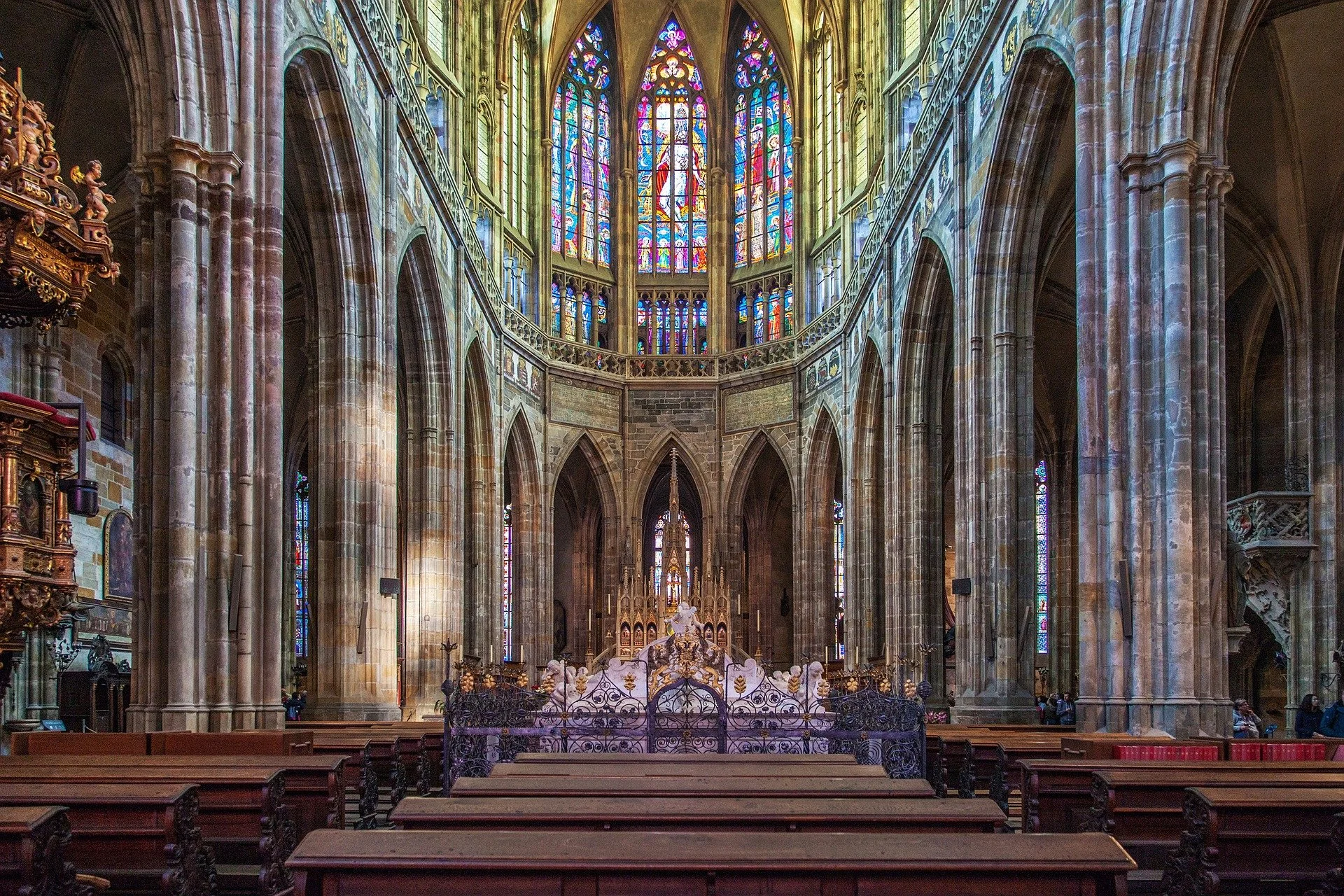
A huge cathedral loomed on our left. Looking up—the car roof was inexplicably no impediment—I was impressed by its architecture, the beauty of its design, the complexity of it. A cluster of roundnesses. Not domes but repeating bands of stone lined with windows, an abundance of windows. (The view we had almost made it seem we were inside it.) The windows weren’t were tall but not huge, had some kind of angular tracery—long, very slender triangles pointing down from the top, up from the sill, reminiscent of a backgammon board but with more variation. Not Gothic but fairly intricate. I was impressed by how layered the cathedral was—through the windows I saw sky & more architecture. Many were smashed out.
“It’s abandoned,” I said to Bukowski.
I woke up & glanced at the digital clock: 4:17 a.m. (I seem to recall). Looking back on the dream cathedral, I’m reminded of Dali’s Raphaelesque Head Exploding although his painting is of a single dome doubling as Raphael’s cranium. Wish I had a painting or an illustration of my cathedral, something other than this fading mnemonic photograph of a dream image (& within maybe a year not even that).
A line from Lawrence’s Sea & Sardinia read yesterday: “There is a great, false baroque church, up a wavering vast mass of steps: and at the side a wonderful jumble of roundnesses with a jumble of round tiled roofs, peaked in the centre.” (P. 279.) Town: Orosei. No doubt an influence on my dream.
The yellowish stone of the building we almost grazed I associate with the Mediterranean, but Spain specifically comes to mind, especially Toledo, though only in terms of the stone, not the city itself, which was modern, unlike Toledo, with a lot of old buildings among modern ones. Also, the stone in my dream was actually yellow, not tawny or ambered at night by yellow streetlamps as in Toledo. Spain is, of course, home to Gaudi’s Cathedral, which, though it bears no likeness to my dream cathedral, stands out among the cathedrals of Europe, is inimitable, almost without precedent. And Dali was Spanish so Spain threads these things together. No idea why Spain. Maybe because I’ve been reading Borges, a Spanish speaker.
Bukowski was driving in the dream—makes sense since he’s my elder, the one choosing the route, the guide. Though I haven’t read much Bukowski & am not crazy about his work, I respect what he achieved.
No idea what to make of this dream—or maybe I do. Bukowski earned his never-out-print status by writing the way he chose to write. Never wavered, never compromised. I’m feeling the usual tension w/ my memoir, the usual “How far do I go?” in terms of writing it the way I want to write it. The dream cathedral was an impressive architectural accomplishment, but it was an intact ruin. (I shouldn’t overlook the fact that Dali’s Raphaelesque Head Exploding is a key image in Sun Eye Moon Eye, that SEME’s probably my outstanding literary accomplishment, that I wrote it almost exactly the way I wanted to (other than a couple cut chapters), but, with a handful of exceptions, it was roundly ignored by critics and gained no more readers than the typical small-press novel. So however impressive (or not) SEME is as literary fiction, it’s essentially abandoned.
The dream’s telling me that if I don’t deviate from my vision I can create something on the order of the derelict cathedral but can’t expect much in the way of sales or even critical notice. A monument of such visual grandeur, its architecture like nothing else I’d ever seen—not like Gaudi’s or the typical European cathedral or a domed Byzantine cathedral—the dream cathedral’s hard to ignore.[i]
4/2/26
Caught fragments of a PBS special on neurology (memory & perception primarily). Fascinating to know how the child’s neural connections (lots of rough winding roads without much traffic but you can get to any destination by following them) are so different from an adult’s (a superhighway with lots of traffic & you can get where you’re going fast but only to limited destinations) because the brain essentially shuts down connections that don’t get used. The child uses them all, all things are more or less equally attractive/alluring/interesting. Another analogy documentary used: Adult attention is like a spotlight focused on X or Y. Kid’s is more like floodlights—everything is illuminated.
“I think people with ADHD see things like children,” Nesli said, “with floodlights.”
An observation that’s probably spot-on & maybe explains why I retain some of my early self’s way of seeing the world.
Dismayed to learn, though, that every time we retrieve a memory, we degrade it, erode it slightly or slightly distort it, overwrite it or merge it with something else, or in some other way make it less “true.” It’s like having a photograph sealed in an airtight box because each time you look at it, it fades, something disappears from the background, something that wasn’t there in the original shows up, the colors drain, the contrast shifts, something is different—yet what good is it if you can’t look at it?
This retrieval degradation is why, I’m sure, when I recall the ghost, Charlie, the memory is now so vague it’s a memory of a memory, an impression of the original, although for years it was clear & I have no doubt at all about what I saw. So as I write this memoir, I’m effacing the memories it’s based on.
[i] Made final revisions today (8/7/26) to “Dream Cathedral.” About an hour later, while rereading a few pages of Jack Kerouac’s Visions of Cody, came across “St. Patrick’s Cathedral: most striking of the windows and I didn’t expect strikingness at this late hour—is at upper front left—a lonely icy congealed blue with streaks of hot pink—little blue holes—painted with an immeasurable blue ink … no sky has had the color of this glass ….” Yesterday, in Benjamin Labatut’s When We Cease to Understand the World, I read about the invention of Prussian Blue, “the first modern synthetic pigment,” which was such a dazzling blue its creator “thought he had discovered hsbd-iryt, the original colour of the sky (pp 14-15). I don’t think these tiny coincidences are marks on the path indicating I’m going the right way. I’ve always noted them, whether I’m up to something hare-brained & disastrous or something worthwhile. They just intimate the presence of threads--so fine as to be invisible--connecting inner and outer.