Spuyten Duyvil | 2024
Excerpt
Uncle Cal had never brought Logan a thing Logan’s mother hadn’t put him up to. Unless it was something he’d killed. Nothing Cal liked better than a hunting trip, which usually meant a drive up to Flagstaff. But every now and then, he brought down a hare outside Phoenix. He’d slap the animal on the kitchen table belly up, spread the hind legs, and poke the hide below the ribcage with a wicked-looking hunting knife. The hide split with a soft pop, and the gash widened as Cal worked the knife upward.
He made Logan stick his hand in the red hole he’d opened up and scoop out the entrails. Still warm. Blood and a sulfurous stink from the wet foundry of the intestines stung his sinuses. No wonder it was rumored to be the reek of the underworld.
“No, not like that.”
Cal pulled Logan’s hand away. “Two fingers.” Cal held up two of his own, thick enough, strong enough to break tiny furrows in winter earth. He told Logan to start up near the breastbone, scrape out everything soft with those two fingers. Then he put something small and slippery in Logan’s hand—the heart, like a tiny pyramid. He looked up, afraid to tell his uncle he didn’t want to feel around inside a dead animal, but Cal saw it on his face. Cal shook his head as he wiped off the blade. “Bushmen in Africa squeeze the water out of animal guts they got it so hard. Be grateful you don't have to stick your nose in there and suck a handful of innards when you want a drink.”
All Hopi, Cal was short and squat. His head hung low on his stocky body as if he’d been made to carry heavy things over long distances. His forearms were thick, his face wide and marked-up from fighting. One scar made a seam in his lip. The other was a jagged streak through an eyebrow.
About the only thing Logan had ever asked Cal for was the beak of a game bird. But Cal broke it off too short with his impetuous over-goddamn-sized fingers. Long and elegant on the bird, it ended up in his palm in pieces, hardly recognizable. Cal had given it a try, though, he really had. It just wasn’t in him. There wasn’t any sympathy, no innate feel for the rest of the four-leggeds, two-leggeds, wingeds, no-leggeds sharing the planet. The Maker, maybe, had been running out of earth when shaping Cal, had had to reach up high for some moon dust to mix in. Cal couldn't be blamed; his bones were heavy not with calcium, but with memories of a waterless, airless, heatless expanse that stretched across his whole life, from nebulous conception to that long walk toward the last hill in the distance.
What was it like to be held up by bones filled with elemental knowing, knowing that the whole goddamn shebang is mostly empty space, from atom on up to galaxy, with suns spread so far apart goddamn centuries would pass if you tried to reach one, and what ain't empty space is 99 percent helium and just-waitin’-for-an-excuse-to-explode hydrogen? So here we are in the middle of more emptiness and burning gas than the human mind could even begin to gander at and when you had a little moon dust instead of marrow in your bones, you knew a little better how it felt when not one living breathing thing, not a stone, not one airy, masked katsina gave a goddamn what desert you disappeared into, what vacuum freeze-dried you. You weren’t quite so bewildered when you got stranded where there wasn’t another voice to speak your name, when you were left gasping for air or a little fatherly take-notice—it was all the goddamn same to the ground you wound up stuck in.
After Logan's father died, Uncle Cal was always over the house, reeking of the moon desolation some part of him must have dropped out of. Always with the excuse of checking up on them. Anything I can do to help?
Logan had never seen his uncle so neighborly. There got to be long goodbyes, the screen door creaking as Logan’s mother let it close but opening again because Cal thought of something else to say. He started coming over for dinner straight from the garage where he worked. Logan would sit next to him for an awkward minute or two. Cal would turn and say something like, “How was school today?”
Hands held stiffly on his thighs, he’d say, “Pretty good.” He’d try not to sit too close because when Cal talked he got a whiff of something sweet as rotting fruit, sour as old blood. Maybe cigarettes had done that. Maybe secretly Cal had been eating the scraped-out offal he was supposed to have thrown away.
Logan left the room while Cal sat in front of the tv drinking beer, his eyes as still and concentrated as a snake's. He liked to wear a sleeveless T-shirt around the house, and Logan got used to seeing the skull grinning between a pair of outstretched wings tattooed on his left arm. A dull tattoo that didn't show up all that well on Cal's dark skin. Logan had been in the room the day his mother asked him what he'd gotten it for.
“After death you take flight,” was all he said. Then he bent down and shoved an arm bumpy with muscles—like a sack of rocks—in Logan’s face.
The tattoo on his right arm was just the number 13. Logan never asked him what it meant.
Reviews
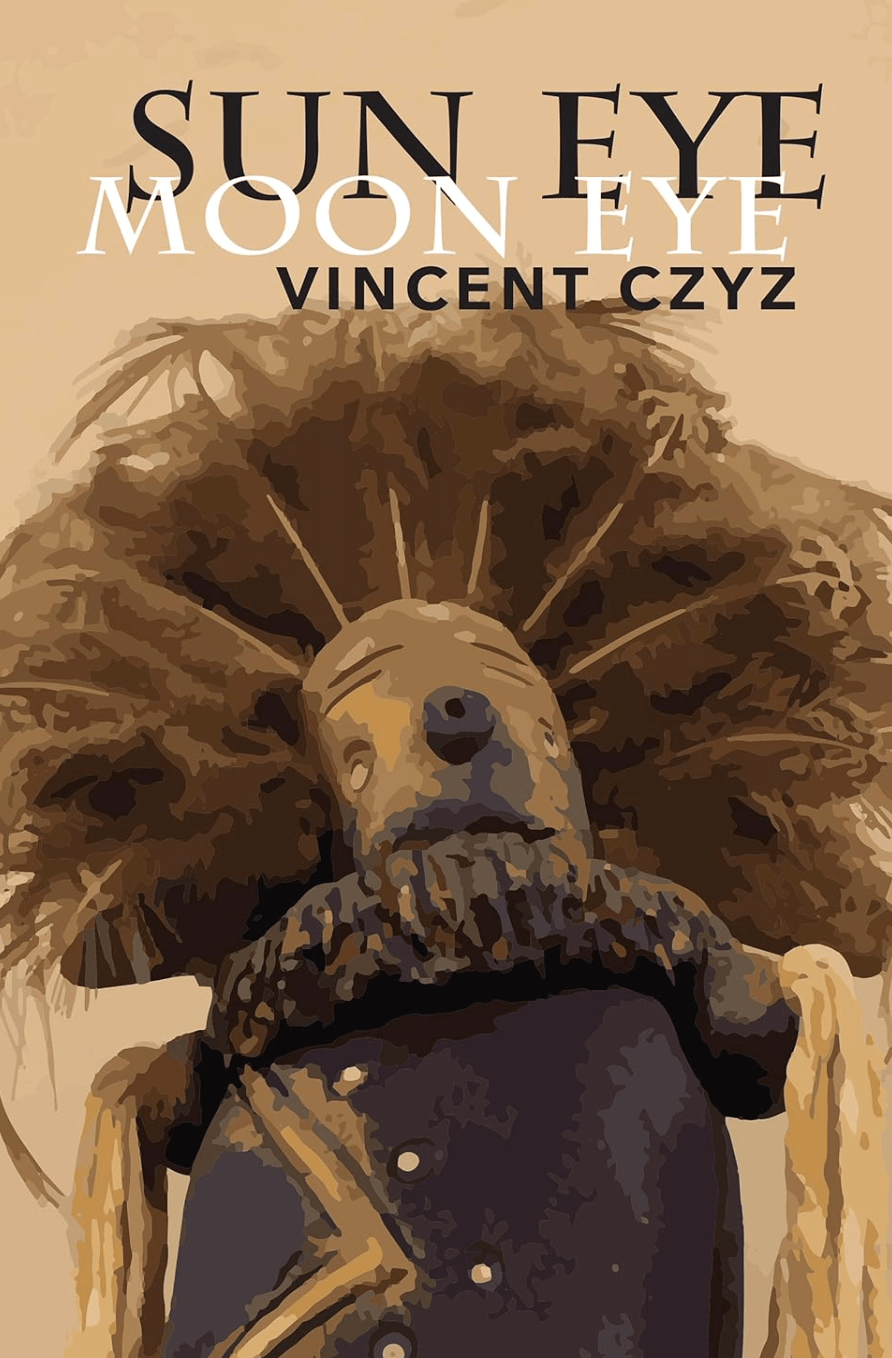
Sun Eye Moon Eye, a finalist for the Big Other Readers' Choice Award, centers around Logan Blackfeather, a musician of mixed Hopi descent, whose faulty sense of direction sends him spiraling through the mid-’80s. The novel opens with Logan crossing a stretch of Arizona desert, his thumb out for a ride and most of what he owns in a bag slung over a shoulder. By this time he has suffered a breakdown and given up music. A knife fight in the parking lot of a roadside bar ends in the death of a trucker, and in short order Logan finds himself in a psychiatric hospital in New York. He makes his way to Manhattan, where he’s as bewildered by the fluorescent-colored spikes of punks as he is by the upturned collars of yuppies. A job as a piano man in a Village bar eases him back into music, and he falls into a turbulent relationship with a successful ad executive. Haunted by a dead father who comes to him in dreams, by the killing of the trucker, and memories of his violent uncle/stepfather, Logan is caught between tradition and modernity, the rural and the urban, his Anglo and Native American ancestries. Myth and dream play key roles in reconstructing Logan’s worldview, and he begins to suspect that empirical reality is as open to interpretation as the dream world.
“Sun Eye Moon Eye engages and entertains, alternating rhapsodic, almost-hallucinogenic language with clean prose that grounds the reader and clarifies the action. [...] an important contribution to literature’s compendium of significant works.”
—Anne Welsbacher, writing for Indie Reader
“Captivating ... a lyrical masterpiece.”
—Seattle Book Review
“The novel … [pulls] us irresistibly into a story whose characters are sympathetic and vividly drawn, whose writing lyrically evokes Logan’s dreams and nightmares—whether along the abandoned highways and landscapes and habitations of the southwest or the grimy corners of Manhattan—and whose hallucinatory perspective never loses sight of the world as it is. That the novel dwells in this rich cross-current—intersections of spirit, politics, history—without losing sight of Logan’s humanity, and our interest in his fate, is the finest achievement of this visionary novel.”
—Tamas Dobozy writing for Vol. 1 Brooklyn
“Sun Eye Moon Eye is a violent, magical ride that transports us to the human psyche’s farthest corners and warps reality and the dreamworld so that the two are inseparable.”
—Heavy Feather Review
“It’s an astonishing denouement, the narrative melting away, until we’re left in another kind of desert, populated by phantoms, by tricksters, by the dead, where language is mere symbols smeared on a crumbling wall, and the fallen arches of Ozymandias are consumed by sands …This book was worth the wait. In gold.”
—John Patrick Higgins, writing for Exacting Clam
“Readers and libraries seeking powerful descriptive language, a stark contrast between past and present worlds, and influences that drive a fallen character to envision new beginnings ... will relish the atmospheric, evocative” sentences.
—Midwest Book Review
“Compelling … reading the book felt like reading a dream.”
—Portland Book Review
“The experience of reading the book, pondering its mysteries and savoring its power, feels timeless.”
—The Arts Fuse