Excerpt
In spite of his erudition, he didn’t foresee that a stomach ailment would drastically alter the shape of his days in Zamoya. The amateur astronomer and haphazard alchemist, who was certain that there was a medium—far subtler than the fragrance a woman leaves behind on a pillow—through which heaven communicated its will to Earth, suffered terrible cramps and fever, as well as painful and frequent movements of his bowels. After the last of his self-administered remedies had failed, he sent Ahmet to fetch the apothecary. Ahmet returned with profuse apologies: not only had he failed to bring the apothecary but accompanying him into his master’s bedroom was a woman whom the apothecary had claimed as his superior in medical matters.
Ibn Oraybi was in too much discomfort to protest a woman in his bedroom, but he immediately doubted whatever healing abilities Annin Nodravna might possess in spite of the creases time had given her face and the knowing way her hands felt first his wrist and then his forehead, the attentive ear she put to his abdomen and the carefully chosen places of his body where she pressed. When she’d finished her examination she leaned out the bedroom window and called to Engil. They spoke in Tazta but Ibn Oraybi was confident she was asking for something to be brought to her.
Engil returned perhaps half an hour later with a handful of roots. Annin Nodravna boiled them into a tea which Ahmet served his master. “Do you think we can put any faith in this woman’s cure?”
Ibn Oraybi took the cup of tea. “I doubt it will make me any worse.”
Annin nodded and smiled, her cheeks forming balls under small eyes that diminished to tiny curved bows. She encouraged him in her Slavic dialect, which was similar enough to Russian that he had little difficulty understanding her.
Turning to Ahmet he said, “Well, it isn’t altogether unpleasant.” He drank five more cups before it seemed to him—in his feverish state—that his soul, with no instructions from him, was wandering off. Afraid it would be mistaken for a ghost and driven farther away by clanging pagan rituals utterly alien to its experience, he called to it to return.
“Ghosts,” his soul answered, “are nothing more than memories dispossessed of their bodies, perpetual habits that outlive the people who performed them. Do I look like a habit?”
Ahmet, whose voice he could hear but whose face he couldn’t see, warned, “Why take chances? Night is falling and this place isn’t so desolate that it will be without ghosts. Who knows what they’ll look like?”
Ibn Oraybi, surprised to hear Ahmet talking about ghosts rather than djinns, disagreed. “If one approaches the topic of ghosts scientifically, it becomes clear that the time when ghosts move about is during the day since they’re solitary by nature and at night there are too many dreams wandering around in the dark and getting in the way. But I doubt the Tazta are capable of such subtle distinctions.”
Then he heard Annin Nodravna’s voice: “A ghost is a shadow from the World Behind the World that has been cast onto this one, no one knows how. Dreams sometimes come from the same place.”
Ahmet said, “The ancient Greeks believed dreams entered the bedroom of the sleeper just as though they were visiting relatives in the middle of the night.”
“The ancient Greeks anthropomorphized everything!” Ibn Oraybi snapped. At the back of his mind, however, he was pleased Ahmet had remembered something he’d told him.
His soul went on, “When you’re just waking or just falling asleep, during the twilight or dawn that has nothing to do with the sun’s rise or fall, you may feel someone in the room with you—a memory dressed up as though it still inhabited a body, or a dream about to enter your sleep, or a dream just leaving the room as you wake. There are so many in the city they overlap. To the untrained eye, they’re not individual shadows with varying lengths, differing spans, and unique shapes, but simply darkness in which the profile of the city becomes a blur.”
This was all he remembered before waking early in the morning of the next day.
Reviews
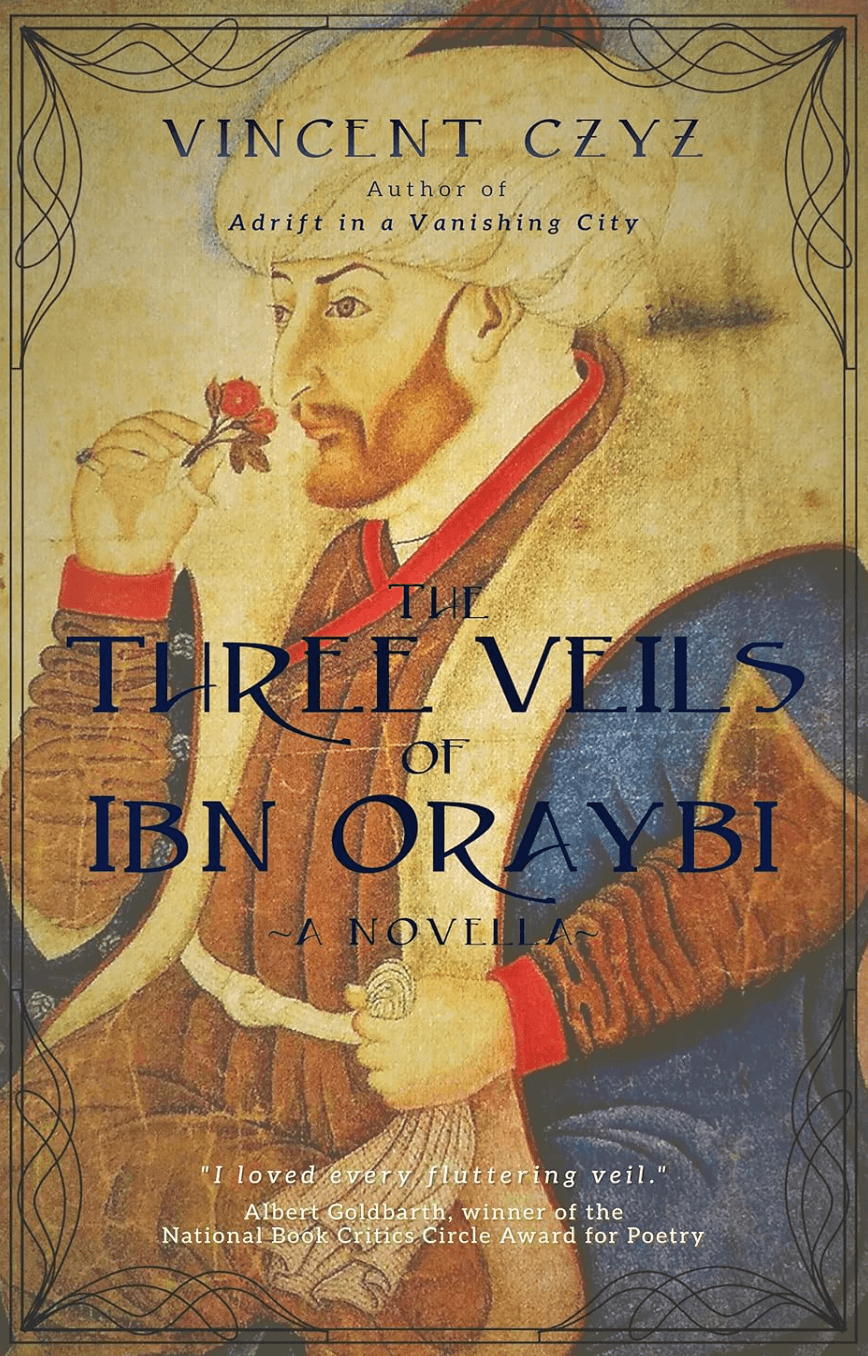
Set in the fading Ottoman Empire of the nineteenth century, The Three Veils of Ibn Oraybi is a tale of regret, revenge, and redemption.
Accused of heresy by a powerful Ottoman pasha, an aging Turkish alchemist flees his native Constantinople, exiling himself to a small town in the hinterlands of the East. A Muslim and a foreigner, as well as a man of letters, he finds life among a populace of stubbornly pagan peasants difficult. Yet when the pasha tracks him down, Ibn Oraybi realizes that the rural folk he’s settled among are quick witted, resourceful, and fiercely loyal. Suspecting he has more to learn from them than they do from him, he reveals the secret that has haunted him for so much of his life.
Praise for The Three Veils...
"I read it in one wonderful sitting ... a splendidly compelling and unique narrative voice."
—Robert Olen Butler, winner of the Pulitzer Prize for fiction
“I loved ever fluttering veil.”
—Albert Goldbath, two-time winner of the National Book Critics Circle Award for Poetry
“Czyz weaves mystery, history, religious fervor, and social inspection into this story of struggle, which ends with a surprising twist... Its lovely, lyrical language and thought-provoking encounters not only bring the times to life but explore the politics and psychological profiles of cultures that lived side by side, but in very different worlds.”
—D. Donovan, Senior Reviewer, Midwest Book Review
“The Three Veils of Ibn Oraybi is an enchantment, that rare fusion of poetry and fiction, intellectual query and sensuous revelation, narrative tension and ease of telling. In the context of a deadly struggle between dogma and reason, it spins a tale of loyalty and betrayal in which powerless women alter the fates of powerful men. Enriched by pagan and Islamic lore, it transports the reader in fresh ways to wise places. Once I started reading it, I couldn't put it down until I finished it.”
—Donald Levering, author of Previous Lives and winner of the Tor House Robinson Jeffers Prize in Poetry
Papillon du Père Publishing | 2021