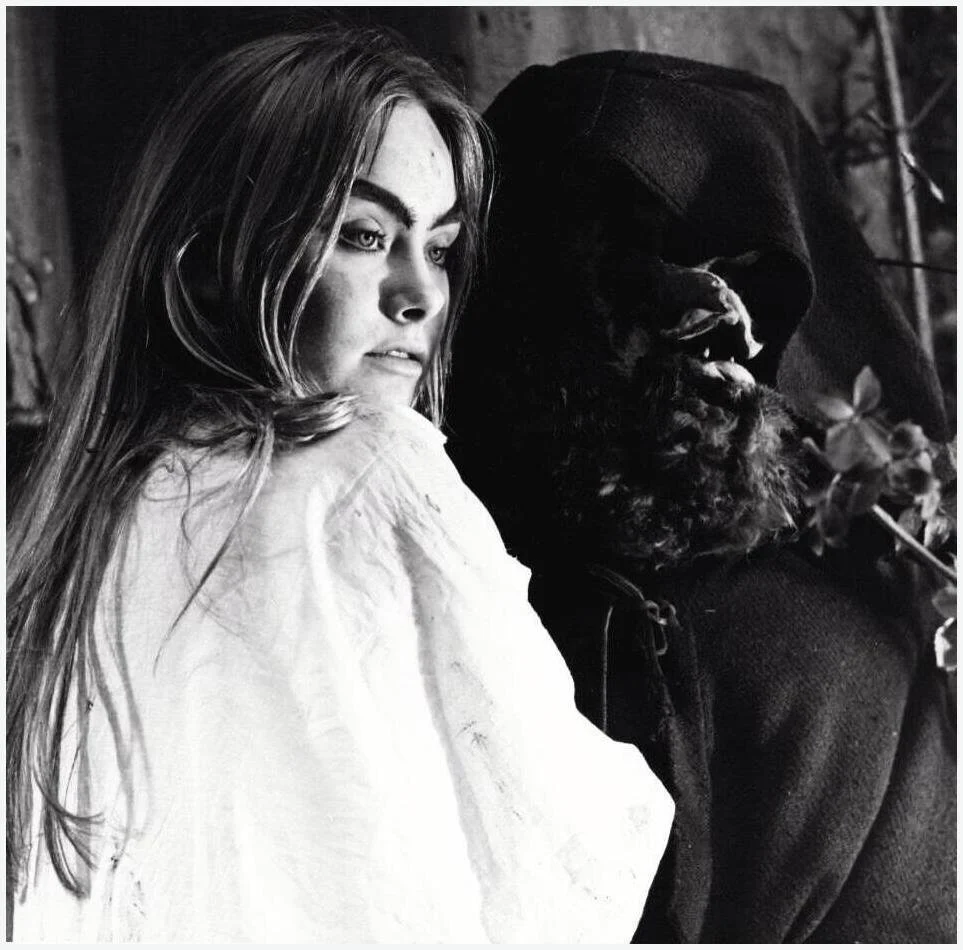
The cellar “is first and foremost the dark entity of the house, the one that partakes of subterranean forces. When we dream there, we are in harmony with the irrationality of the depths.”
—Gaston Bachelard
The Blood on Satan’s Claw, set in rural England in the 18th century, debuted in cinemas in 1971. A low-budget tale of supernatural horror directed by Piers Haggard, it’s now something of a cult classic. Dad took Bobby and me to see it at a drive-in theater one warm August evening. We were 9 and 8.
For years I carried around a single clearly defined scene from the film, a brief sequence still immersed in the emotions it evoked—fascination, fear, wonder—a kind of souvenir I couldn’t donate to a Salvation Army store or relegate to the closet. Probably my first drive-in movie was part of it, being outside as dusk deepened to star-flecked black rather than sitting in the artificial dark of a movie house. The film began rolling before night settled in, and the sky, in an opening shot of the film, was almost the same color as the fading blue behind the screen so that the English countryside seemed to be projected on the sky itself. Looking back, I still find this conflation of sky and screen almost mystical.
The scene I never forgot centers on a young blonde accompanied by two men as she comes down the stairs from an attic. Her arms have been bound by a swatch of black cloth (a makeshift straitjacket). Her close-mouthed smile is disturbing. Her gaze is that of the insane. But the part that fixed this in my memory for more than half a century is that when she rests her hand on a newel post, there are no fingers, just wickedly long claws—claws she didn’t have before she stayed the night in the attic (nor had she been mad).
I daydreamed sporadically over the decades about watching The Blood on Satan’s Claw again to see how the film, which had made the child me into a voyeur viewing someone else’s nightmare, would affect the adult me, but had never gotten around to it. I recently saw a still from Satan’s Claw in a social-media post, and I finally tracked down the 1971 release and gave it a second go.
The one intact scene I recalled was surprisingly undistorted by memory. I’m not sure why I found it so frightening although the eerie music and the young woman’s disconcerting smile helped. Maybe the idea that a human being could transform into something inhuman, something bestial and supernatural at the same time. Perhaps revert to something inhuman.
I sensed even then that the film, rated R, probably wasn’t appropriate for kids. A second viewing confirmed my little boy’s intuition. Some of the incidents I forgot: a rape scene (fortunately, I was too young to understand exactly what was going on); the fatal stabbing of the young rape victim; the full frontal nudity of the lovely Linda Hayden as part of an attempted seduction; a doctor cutting away a furry patch of “Devil’s skin” from a young woman’s smooth thigh. Each of these scenes, as well as others, strikes me as at least as shocking to a child of 8 as the smiling madwoman descending the stairs and resting her new-grown claws on a newel post, yet they didn’t make the same impression. And I had no recollection whatsoever of the film’s ending, which featured what I, at 8, would’ve called a “monster” rather than merely the claws of one. This is particularly odd since all through my childhood I loved movies that featured monsters or weird aliens and would watch a whole film just get to the end, where we finally get a good look at whatever’s been terrorizing the humans in the film.
Along with forgetting 99% of the movie, I made outright mistakes: I thought Mom was with us, but we spoke about on the phone and she hadn’t been at the drive-in. Nor did she see the film anywhere else. Suddenly I remembered it’d only been Bobby and me. She’d stayed home with Tony, who was 6. So there was an age threshold below which Dad wouldn’t go, at least with us boys; despite being an adult, my mother wasn’t allowed to watch Satan’s Claw, among other movies. This was an odd psychological tic of my father’s: he wouldn’t let my mother see nudity of any kind, male or female, or watch sex scenes. I recall that my teenage brother and I watched such scenes with our father—this was when HBO was first showing movies on cable tv—but my mother was sent out of the room.
A mistake taken for truth long enough becomes, of course, psychological fact. My biggest mix-up was “recalling” that the film began in a bygone century and concluded in 1960s or ’70s. Somehow I retained a scene of enthusiastic foreplay between a couple in contemporary clothing, on hay heaped in a ruined barn, as part of Satan’s Claw, but Satan’s Claw never leaves the 18th century.
While I forgot 99% of the film’s visuals, I had a clearer recollection of how the film affected me. There was something mesmerizing, even magical about it. Yes, certain scenes caused icy blades of fear to form, but the movie insisted, whatever my atheist father said, that the supernatural couldn’t be ruled out entirely—a thrilling possibility. The world’s mysteries, the film seemed to assure me under its breath, are bottomless, and uncertainty can never be eradicated from the universe. Satan or some other agent of evil might go through that same unclosable door, but I had a child’s optimism, reinforced by the film’s finale, that white magic would win out over black. I also had faith in my father. Sure, a madwoman with wicked claws was scary, but she didn’t have a prayer against Dad if he flew into one of his rages.
I’m still not sure why the staircase scene is the only one I could remember with any clarity. Maybe because so much was implied—what had transformed her? How had she grown claws on one hand? Why was she now mad? Maybe because, with so much left unsaid, the scene fronts an unknowable enigma.
It’s no accident that the young woman descends from an attic, which, like a basement, often symbolizes the unconscious although unlike the basement the attic is an underworld only at night (or in darkness). The dust-collecting antiques abandoned in its shadows suggest older, alien aspects of the self. In retrospect the film itself seems a trap door leading to an attic (or a basement), that is, a portal to some unconscious passage or other, and so in a sense is a reflection of a reflection.
And what about the roll in the hay I’d somehow inserted into Satan’s Claw? While getting some background on Piers Haggard’s bit of “folk horror,” I learned that it was often half of a double feature at drive-ins. The other half was The Beast in the Cellar, another British import. Had we watched both films? The title seemed dimly familiar, like it might belong to something I’d seen with my mom on late-night tv, but watching a trailer didn’t stir any dormant memories. Unwilling to give up on Beast, I found a grainy, scratched-up copy on the ’net, and, at the 27-minute mark, found what I was looking for. Although I’d distinctly recalled the woman’s black leather jacket, I had remembered it as short—a motorcycle jacket—when in fact it was mid-length and had buttons rather than zippers (she does, however, enter the scene on the back of a motorcycle). I’d recalled that the two are interrupted—amorously distracted as she is, she is sure they’re being watched—but not that the scene ends with his violent death.
The rest of the movie, however, was either a blank or, as with the vaguely familiar title, just beyond retrieval, like a word on the tip of my tongue. Why, I wondered, had I all but entirely forgotten the film and spliced the one scene I remembered onto Satan’s Claw? Why was the barn erotica, vastly different from the only mnemonically intact scene in Satan’s Claw, the only scene I remembered? Why didn’t I recall that the man is slashed to death at the scene’s end? It’s not very gory. but blood spattered on her skin, bestial snarling, and human screams don’t leave much doubt as to what happened.
The first riddle I chalk up to the memory-work, which, like the dream-work, has a tendency to distort, delete, merge, and compress for reasons more often than not inscrutable. An AI summation: “Dreams and waking memory operate in similar ways, relying on an overlap of imagination, fact-retrieval, and subconscious ‘editing.’”
The second: it was erotic. even to my 8-year-old self.
The third: I probably repressed the man’s bloody death since it tainted the titillating stuff.
I’m also guessing that I fell asleep—Beast must’ve ended well past my bedtime—and missed at least half the film. This would explain why I have no recollection of so much of Beast, including the thoroughly disappointing and just as thoroughly unconvincing ending.
In Satan’s Claw a shaggy demon, if not the ruler of hell himself, tries to emerge into the world through a farmhouse attic. In Beast a murderous creature resides in the basement of a rural cottage. I doubt that pairing horrors associated with an attic and a basement—both associated with the sinister and the unknown—was a deliberate consideration, but it might’ve been an unconscious one.